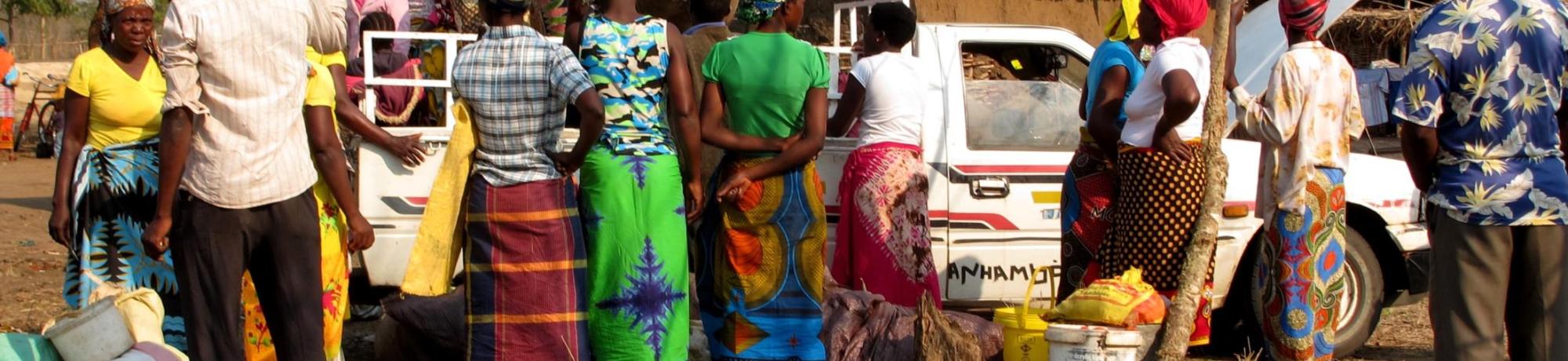
New results show that a prominent poverty graduation program for women in rural Kenya significantly increased business assets, income and savings for most participants with additional benefits for nearby women who did not take part in the program.
MRR Innovation Lab associate director Tara Chiu has been appointed co-chair of the InsuResilience Global Partnership Impact Working Group and will help to build a broader dialogue around evidence and impact.
In this Q&A, Dr. Florence Kyoheirwe Muhanguzi discusses the many challenges women smallholder farmers face in Uganda, as well as her new field study that tests ways to increase women’s productivity, empowerment and resilience to shocks.
The University of California, Davis, has established the Resilience+ Innovation Facility to spark inclusive agricultural transformation among small-scale farmers in Sub-Saharan Africa and South Asia with a $5 million five-year grant from the Bill & Melinda Gates Foundation.
New paper reports that targeted fertilizer recommendations paired with subsidies to purchase fertilizer can increase maize yields on small-scale farms in Tanzania. Soil tests also showed that a change in fertilizer recommendations from the government of Tanzania could address a common deficiency limiting maize yields.
New research from the MRR Innovation Lab and the International Livestock Research Institute makes it possible to objectively evaluate the potential benefits, costs and risks for a nation to adopt disaster risk insurance.
USAID has taken new steps to tackle the global climate crisis by joining three multilateral partnerships through which it helps countries prepare for and mitigate climate-related disasters.
A new study using advanced economic modeling has found that adding insurance for families who are not yet poor is the most responsive and cost-effective way to reduce total poverty.
For this International Women’s Day on March 8th, we highlight some of the critical innovations the MRR Innovation Lab is supporting to help women in vulnerable rural communities mitigate the risks they face.